Letter-join’s updated Letter Family section includes more resources, worksheets and a Lesson Planner for teaching handwriting using letter family groups.
Teaching sequence
Letter-join’s letter families follow the most common, developmental order for teaching letter formation.
Pre-writing Patterns help children build gross and fine motor control using the fundamental lines, strokes and shapes before learning to form letters.
Ladder Letters use simple, straight up and down hand actions, building instant confidence, as children find these movements easiest to master.
Caterpillar Letters curve around with the same circular movements, reinforcing one basic hand action.
Robot Letters start with a vertical stroke, then go up and over. Children learn to change direction and loop around, preparing them for more complex handwriting strokes.
Zig-zag Letters use diagonal lines which have sharp changes in direction. They require a bit more precision and fine motor control.
Each lesson uses online animations and IWB tracing activities with printable worksheets for real handwriting practice.
Once pupils have mastered the formation of the individual letters in each letter family, they will move on to practising pairs of letters before progressing onto words including the letters from each family.
When children are secure in forming the letters within words in each family, this will create the natural basis for linking letters together and prepare them for joined handwriting in Key Stage Two.
Letter Families Challenge
The Letter Families Challenge is a fun activity designed to support children’s letter formation, helping them to understand which families each of the letters belong to. Pupils can independently practise the letters on screen and are rewarded with stars for accuracy and a cheer when the task is completed.
Handwriting fonts
Schools can choose to teach handwriting with Letter Families using either an unjoined or a cursive font.
Online and printed resources will be displayed in the font you have selected for your class.
Dedicated Lesson Planner
The Letter Families Module delivers a route into starting the teaching of handwriting which can be used as an alternative to Module 1 Print or Cursive.
Each set of lessons begins with pre-writing patterns, followed by the learning of letter formation and then pairs of letters, before moving onto words using the letters from each family group.
Teachers can download the Lesson Planner from their Class Home page by selecting Info, then Lesson Planners and either the Printed route or Cursive route.

A progressive set of Letter-join handwriting activities for tracking skills development and writing fluency.
Letter-join’s Handwriting Assessment Tracker has been designed in line with the 2025 Writing Framework and National Curriculum targets for handwriting and provides a complete scheme for assessing pupils’ progression in handwriting skills from Early Years to Year 6.
Children’s handwriting development can be monitored termly, annually or as-required throughout their school journey.
Letter-join’s tracker assesses key handwriting features such as letter formation, joining, speed and fluency and helps identify pupils requiring targeted intervention.
Progress can be tracked throughout each academic year, with dates recorded for each assessment and a notes section for further comments and next steps, until pupils are secure in each developmental area. The document can either be printed as a whole or the first section can be duplicated and updated electronically as individual pupil records (pages 1-4), reducing print time and costs.
The tracker is a useful resource for when children transition between classes and year groups, ensuring that receiving teachers have a clear understanding of each pupil’s handwriting ability.
Assessment pages are provided for each year group with guidance for teachers and handwriting tasks for children to complete. Pages should be duplicated for assessments that are carried out on a termly basis.
Letter-join’s Handwriting Assessment Tracker also provides photographs of handwriting examples modelling expected handwriting standards for each year group.
Download the Assessment Tracker from the Lesson Planners page, or by typing ‘tracker’ into the search bar (Letter-join School subscriptions only).

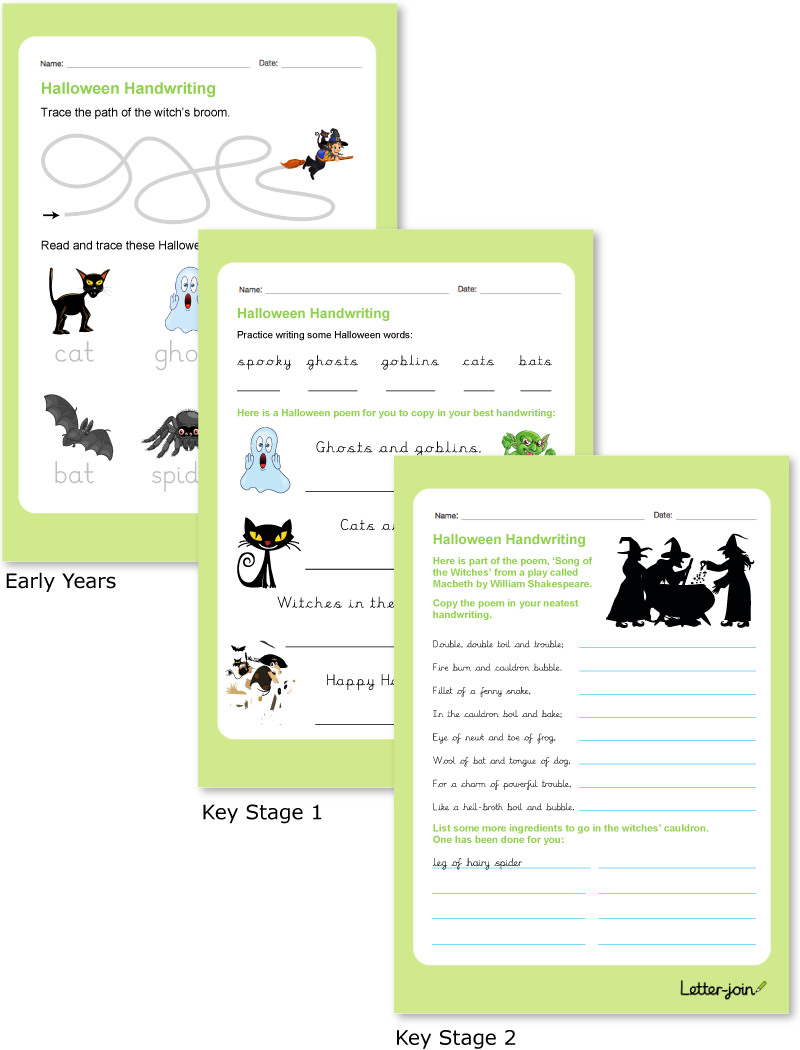
Letter-join has a selection of fun and engaging Halloween resources to encourage handwriting practice.
As with all Letter-join activities, your school’s preferred letterforms for f, k, w, x and z will be used and the font, printed or cursive, will be as chosen by class teachers.
The worksheets and craft activity are available for Early Years, Key Stage 1 and Key Stage 2.
To find Letter-join’s Halloween resources, type ‘halloween’ into the Search bar.
For more seasonal practice worksheets, such as Bonfire Night, Remembrance Day or Diwali, just search 'autumn'.
Support your pupils with the physical demands of handwriting by establishing fundamental pre-writing routines using Letter-join’s Ready to Write Resources pack.
This offers teachers a handy set of resources in preparation for handwriting, including:
• a PDF guide
• a selection of classroom posters
• links to fun, interactive videos to boost fine and gross motor skills
Display
A set of key handwriting resources, including an IWB presentation and posters modelling:
• Posture
• Pencil grip
• Paper position
• Pencil pressure
Videos
A series of lively videos are included in Letter-join’s Ready to Write Resources pack to help motivate your class. Have fun as pupils practise the animated activities to get them ready to start handwriting.
The engaging routines modelled in the videos can be integrated into daily classroom activities.
A lively, seven-minute warm-up session encouraging children to copy large, whole-body movements.
A focused, five-minute selection of fun exercises designed to improve strength, dexterity and control in fingers and hands in readiness for handwriting.
Clear, step-by-step guidance for learning the tripod pencil grip method, accompanied by a memorable rhyme.
An extended ‘How to Hold a Pencil with warm-ups’ video combining selected gross and fine motor skills activities is also available.
To explore the resources, download Letter-join's Ready to Write Resources pack as a PDF.